
Rainwater Harvesting Tank Sizing
Correctly sizing a rainwater harvesting tank is the single most important engineering decision in any UK commercial harvesting scheme. An undersized tank overflows frequently and fails to meet non-potable demand; an oversized tank stagnates, increases capital cost and adds no usable yield. This guide explains how ViaCon sizes commercial rainwater harvesting tanks for UK projects, following the BS EN 16941-1:2024 methodology and Met Office rainfall data — and shows how sizing decisions interact with BREEAM credits and payback periods.
For an overview of the complete system, see our rainwater harvesting systems page. For installation guidance, see our rainwater tank installation information.
How to Size a Commercial Rainwater Harvesting Tank
Tank sizing follows a supply-and-demand calculation:
- Supply input = roof catchment area × annual rainfall (from Met Office FSR/FEH regional data) × hydraulic efficiency (typically 0.80–0.90 for pitched tiled roofs, 0.50 for flat green roofs)
- Demand input = daily non-potable use × operational days per year (WC flushing, urinals, irrigation, vehicle washing, process water)
- Optimum storage = typically 18–21 days of average demand, or 5% of annual yield — whichever is smaller
Under-sizing causes frequent overflow and lost yield. Over-sizing inflates capital cost without proportional benefit. BS EN 16941-1 provides a simplified method based on the smaller of the two 5% calculations, which ViaCon uses as a starting point before refining against project-specific demand patterns.
Cost efficiency
By reducing the reliance on potable water for non-potable uses, rainwater harvesting tanks can significantly lower water bills and operational costs. This makes them a cost-effective solution for businesses and municipalities looking to manage water resources more efficiently.
Environmental impact
Our tanks help mitigate the environmental impact of stormwater runoff by capturing rainwater before it reaches drainage systems. This not only reduces the risk of flooding but also prevents pollutants from entering natural waterways.
Durability and longevity
Made from high-quality materials, ViaCon’s rainwater harvesting tanks are built to withstand harsh environmental conditions and provide long-term service with minimal maintenance. This ensures a reliable water source for years to come.
Versatility
Our tanks can be integrated into various systems, including existing infrastructure, making them a versatile option for different types of projects. Whether you’re managing a small commercial site or a large industrial complex, ViaCon’s rainwater harvesting tanks offer the adaptability needed for efficient water management.
Rainwater Harvesting Tanks: Engineered Underground Storage for UK Projects
A rainwater harvesting tank is the central storage component in any rainwater harvesting system. It receives filtered roof runoff and holds it until demand triggers the pump set to distribute water to non-potable outlets. Tank selection directly impacts system performance — capacity, burial depth, structural rating and material longevity all determine whether the installation delivers reliable savings over its operational life.
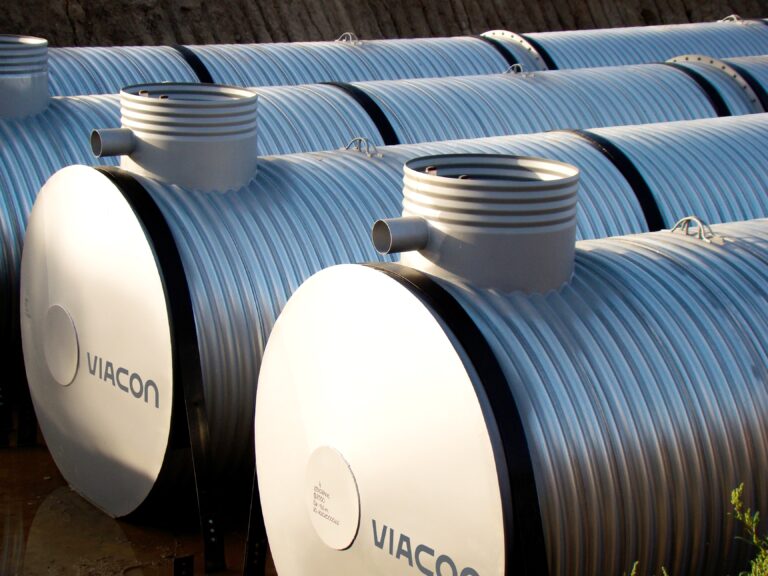
ViaCon’s corrugated steel rainwater harvesting tanks are purpose-engineered for below-ground installation on commercial, institutional and infrastructure projects. With hot-dip galvanised protection providing design lives exceeding 100 years, these tanks outperform plastic crate alternatives on every key metric: structural integrity under traffic loading, resistance to ground movement, and whole-life carbon footprint.
Sizing Your Rainwater Harvesting Tank
Tank capacity must balance the available catchment area, local rainfall patterns and projected non-potable demand. ViaCon’s engineering team uses BS EN 16941-1 methodology combined with Met Office rainfall data to calculate optimal storage volumes — typically ranging from 10,000 to 500,000 litres for commercial installations. Oversizing wastes capital; undersizing leads to excessive mains water top-up and poor payback.
Each rainwater tank is manufactured to project-specific dimensions and can be configured for single-function harvesting or dual-purpose use combining harvesting with stormwater attenuation. This integrated approach reduces excavation, simplifies pipework connections and delivers both water savings and SuDS compliance from a single asset.
Installation and Maintenance
Steel harvesting tanks install significantly faster than equivalent concrete structures — a typical 100,000-litre system can be assembled and backfilled within two days using standard plant. The lightweight sections (approximately 60% lighter than precast concrete) reduce cranage requirements and minimise ground bearing pressure during construction. Post-installation maintenance is minimal: annual filter cleaning, pump set inspection and a visual check of the tank interior every five years.
Explore completed rainwater harvesting tank projects: repurposing rainwater at East Kilbride Village and harvesting rainwater for sustainable cooling.
Typical Rainwater Harvesting Tank Sizes by Building Type
| Building type | Typical tank size | Roof area |
|---|---|---|
| Primary school | 10,000–25,000 L | 1,000–2,500 m² |
| Secondary school / academy | 25,000–50,000 L | 2,500–5,000 m² |
| Small commercial (offices, retail) | 15,000–30,000 L | 1,500–3,000 m² |
| Large commercial / distribution | 50,000–150,000 L | 5,000–15,000 m² |
| Industrial / logistics hub | 100,000–500,000 L | 10,000–50,000 m² |
ViaCon’s corrugated steel tanks are manufactured as single-unit structures up to 500,000 litres, avoiding modular joints and associated long-term leakage risk.
Sizing for BREEAM Wat 01 Credits
BREEAM Wat 01 credits scale with the proportion of WC flushing demand met from non-potable sources. To hit the 5-credit threshold (75% of flushing demand), the tank must store enough harvested water to cover multi-week dry spells during the heating season — typically requiring the upper end of the range above. The innovation credit (95% of non-potable demand) demands a larger tank or a dual-function design that also supplies irrigation, washroom greywater and cooling.
ViaCon’s feasibility team models Wat 01 scenarios against project-specific rainfall data and occupancy patterns, producing credit-prediction reports suitable for BREEAM submission.
Steel: The smarter choice
The strength and sustainability of steel provides durability and lifespan advantages for construction projects.
Value engineering
With consultative problem solving and the versatility of steel, value engineering ensures adaptable, cost-effective solutions.
Case studies
Payback and Whole-Life Cost
At 2026 UK commercial water prices — which have risen 26% over the 2025–2026 period according to Water UK — typical payback for a correctly sized commercial rainwater harvesting tank is 10–15 years. Whole-life cost is heavily influenced by tank material:
- Steel underground tank — 100+ year design life, no structural slab required, pump and filter replacement every 10–15 years
- Plastic crate system — 25–50 year design life, requires concrete protective slab above, full replacement within facility lifetime
- GRP (fibreglass) tank — 50–70 year design life, higher embodied carbon than steel
For buildings with 60+ year target lifespans, steel typically delivers the lowest whole-life cost per litre of harvested water.Related pages:
Welcome to the ViaCon design toolkit
Contact your local ViaCon representative
Tank size is calculated from roof catchment area, local rainfall (Met Office data), and daily non-potable demand. The BS EN 16941-1 simplified method suggests storing 5% of annual yield or 18–21 days of average demand, whichever is smaller. ViaCon provides free sizing support for UK commercial projects.
A typical UK primary school requires a 10,000–25,000 litre tank (1,000–2,500 m² roof); a secondary school or academy typically needs 25,000–50,000 litres (2,500–5,000 m² roof). Final sizing depends on pupil numbers, operational days and BREEAM targets.
Yes. An oversized tank adds capital cost without proportional yield benefit and can encourage stagnation if overflow frequency drops below twice yearly. BS EN 16941-1 explicitly warns against oversizing — tanks should overflow at least twice annually to flush surface floating debris.
ViaCon manufactures single-unit corrugated steel tanks up to 500,000 litres. For larger requirements, multiple tanks can be linked into a single hydraulically connected storage system.
Our rainwater harvesting tanks are engineered for durability and a long service life. They are made from high-quality materials designed to withstand harsh environmental conditions, ensuring a reliable water source for years with minimal maintenance.
When you choose ViaCon, you get more than just a tank; you get a complete water management solution. Our expertise in engineering and customisation ensures you receive a high-quality, cost-effective system perfectly tailored to your project. We are committed to helping you achieve your sustainability goals through modern, eco-friendly practices.