
Rainwater harvesting system
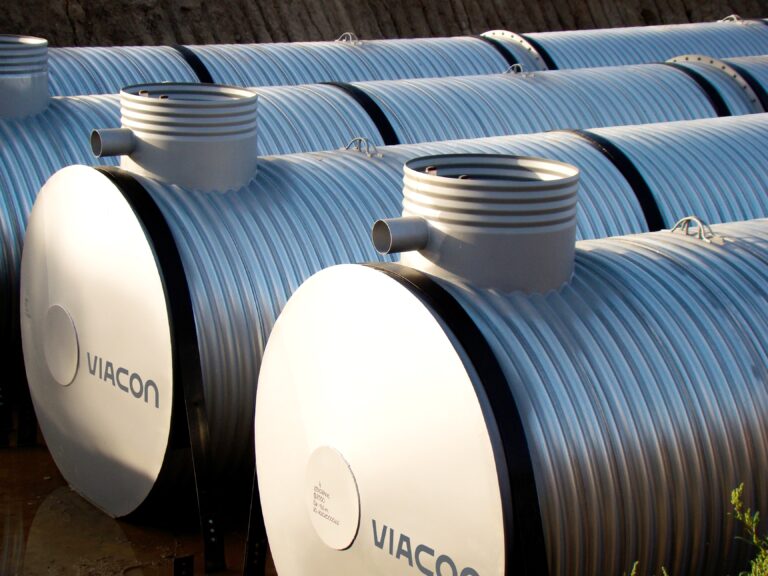
A rainwater harvesting system captures, filters and stores rainwater from roof catchments for reuse in non-potable applications such as toilet flushing, irrigation, vehicle washing and process water. For UK commercial buildings, harvested rainwater can replace up to 85% of mains water demand — reducing utility costs, securing supply against rising water prices, and unlocking BREEAM Wat 01 credits. ViaCon designs and supplies engineered steel rainwater harvesting systems for commercial developments across the UK, from 10,000-litre installations to bespoke 500,000-litre schemes.
What Is a Rainwater Harvesting System?
A rainwater harvesting system is an integrated engineered solution that collects rainfall from a defined catchment area — typically a commercial roof — and delivers it, filtered and pressurised, to the points of non-potable use within a building or across a site. Every compliant system in the UK is designed to BS EN 16941-1:2024 (the current British Standard superseding BS 8515:2009) and includes four functional stages:
- Collection — rainwater is captured from roof surfaces via gutters and downpipes and routed to the storage tank
- Filtration — coarse and fine filtration removes leaves, debris and sediment before water enters storage
- Storage — the rainwater harvesting tank holds treated water until demand arises, sized to balance supply against use
- Distribution — a pump set or gravity feed delivers water to WCs, urinals, wash-down points or irrigation systems, with automatic mains top-up if rainfall is insufficient
For commercial properties pursuing BREEAM certification, harvested rainwater contributes directly to Wat 01 credits and can help unlock Excellent or Outstanding ratings.
Applications
- Parking lots
- Warehouses
- Supermarkets
- Logistics centres
- Parks
- Schools
- Housing
- Roads
How a Commercial Rainwater Harvesting System Works
The design of a commercial rainwater harvesting system depends on three primary inputs: the roof catchment area available, the non-potable demand of the building, and the local rainfall pattern based on Met Office FSR/FEH data.
In a typical UK commercial installation, water flows from the roof through downpipes into a first-flush filter, which diverts the initial (dirtiest) rainfall to drainage. Filtered rainwater then enters the underground storage tank, where calmed inlets prevent sediment disturbance and settlement separators remove fine particles. A submersible pump or external booster set draws water from the tank and supplies it at pressure to the internal distribution network.
Most commercial schemes integrate a mains water top-up — controlled by an air gap or Fluid Category 5-compliant break tank — ensuring supply continuity during prolonged dry periods. Smart controllers monitor tank levels, pump performance and water quality, feeding into the building management system.
For sites where the storage volume also performs a flood attenuation role, ViaCon delivers dual-function systems that combine rainwater harvesting with stormwater attenuation in a single structure — reducing site footprint and cost.
Applications for Commercial Rainwater Harvesting
Rainwater harvesting systems deliver the greatest return on commercial sites with large roof catchments and consistent non-potable water demand. Common applications include:
- Distribution centres and warehouses — large roof areas combined with vehicle washing and fire-water top-up demand
- Schools, colleges and universities — predictable occupancy, high WC/urinal demand, strong BREEAM alignment
- Hospitals and healthcare buildings — high water demand, sustainability targets, long-term payback considerations
- Retail parks and supermarkets — extensive roof areas, sizeable washroom and landscape irrigation loads
- Leisure centres, stadiums and hotels — peak-demand toilet and shower flushing, prominent sustainability positioning
- Industrial and manufacturing sites — process water, cooling, dust suppression and vehicle cleaning
- Office buildings and mixed-use developments — BREEAM-driven specifications, predictable office water demand
On sites larger than 5,000 m² of roof area, a well-designed rainwater harvesting system typically achieves payback within 10–15 years at 2026 water prices — and continues to deliver savings for the full 100+ year design life of the underground steel storage tank.
Rainwater Harvesting and SuDS Compliance
Rainwater harvesting sits at the top of the CIRIA SuDS Manual hierarchy as a prevention measure — capturing rainfall at source before it enters the drainage network. This makes harvesting systems a powerful tool for meeting Flood and Water Management Act 2010 Schedule 3 and NPPF sustainable drainage requirements.
Where local planning conditions require both water reuse and stormwater attenuation, ViaCon’s dual-function systems combine rainwater harvesting storage with regulated discharge control — satisfying both demands in one integrated structure. Steel tanks offer clear advantages here: 100+ year design life, 100% recyclable, traffic-rated for under-highway installation, and 25–40% faster installation than concrete or modular plastic alternatives.
Why Steel Rainwater Harvesting Systems Outperform Plastic Alternatives
Commercial rainwater harvesting systems are typically supplied in one of three storage formats: plastic crate systems, GRP (fibreglass) tanks, or corrugated steel underground tanks. For commercial and infrastructure scale, ViaCon’s engineered steel tanks deliver measurably better long-term performance:
- Design life of 100+ years versus 25–50 years for plastic
- Inherent structural load-bearing capacity — no separate concrete slab required above the tank
- Traffic-rated to Class 1A loading, suitable for under-highway, yard and parking installations
- Single-unit capacity from 10,000 up to 500,000 litres without modular joints
- 60% lighter to transport than concrete — lower carbon footprint, easier site logistics
- 100% recyclable at end of life
For specifiers working to BREEAM Excellent or Outstanding targets, steel’s embodied carbon profile and recyclability often become decisive factors in the whole-life assessment.
Specifying a Rainwater Harvesting System for Your Project
ViaCon supports architects, specifiers, M&E consultants and main contractors throughout the design process:
- Feasibility and sizing — demand modelling against Met Office rainfall data, BREEAM Wat 01 calculation, payback forecasting
- Technical specification — BS EN 16941-1 compliant design drawings, BIM data, structural calculations
- BREEAM and water neutrality support — evidence packages for Wat 01 submissions, water-neutrality statements for planning
- Supply and installation coordination — UK-wide delivery, installation guidance, commissioning support
- Dual-function design — where harvesting and attenuation are both required, ViaCon engineers combined systems
Get in touch to discuss your project — we typically respond to specification enquiries within 24 hours.
Steel: The smarter choice
Value engineering
Case studies
A rainwater harvesting system is an integrated solution that collects rainfall from roof catchments, filters it, stores it in an underground tank, and distributes it to non-potable applications such as toilet flushing, irrigation and wash-down. UK commercial systems are designed to BS EN 16941-1:2024.
On UK commercial sites with large roof catchments, a well-designed rainwater harvesting system typically replaces 40–85% of non-potable mains water demand. Average reported savings from UK installers sit between 40% and 75%, depending on roof area, water use pattern and tank sizing.
Yes. Rainwater harvesting contributes directly to BREEAM Wat 01 credits — up to 5 credits for replacing 75% of WC flushing demand, with a further innovation credit available at 95% non-potable demand replacement. Harvesting also supports Wat 03 leak detection and can unlock Excellent or Outstanding ratings on water-neutral sites.
The current British Standard is BS EN 16941-1:2024 (superseding BS 8515:2009). Additional relevant standards include Building Regulations Part G (water efficiency) and Part H (drainage), BREEAM Wat 01–03, CIRIA SuDS Manual (C753), and the Flood and Water Management Act 2010 Schedule 3.
ViaCon’s corrugated steel underground tanks have a design life of 100+ years. Mechanical components (pumps, filters, controls) have shorter service intervals and typically require replacement every 10–15 years as part of standard maintenance.
Yes — this is increasingly standard on UK commercial sites. ViaCon designs dual-function systems that store harvested rainwater for reuse while providing regulated discharge for flood attenuation, satisfying both water-reuse and SuDS requirements in one underground structure.
Welcome to the ViaCon design toolkit
We have put together a selection of useful tools, calculators, information and downloadable resources to help you find what you need quickly and get the most out of your ViaCon system.