
ViaCon Fire Solutions
Water storage for firefighting
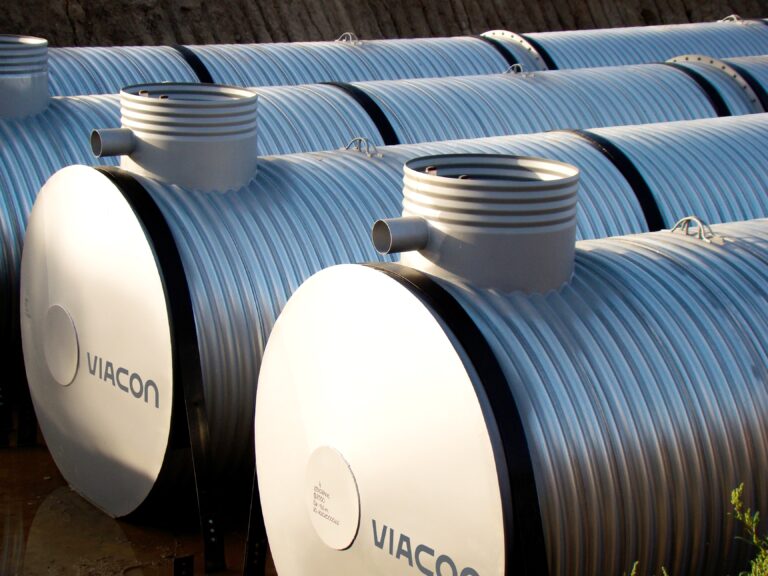
Fire tanks are specialised water storage systems designed to provide a reliable and accessible water supply for firefighting purposes. Typically installed at industrial sites, commercial properties, and remote and residential areas, fire tanks can be equipped with pumps and hoses to deliver water quickly in the event of an emergency. These tanks are usually built to comply with local fire safety regulations and are often located in areas where water pressure may be insufficient or unreliable. The use of a filtration system can be added to filter out any contaminants due to runoff or heavy rainfall to ensure the water remains safe for use in firefighting.
An alternative use can be the collection of the effects from firefighting in certain industries, with the tanks collecting the run-off for managed removal by a waste management company.
Fire Water Tanks: Engineered Steel Storage for Reliable Fire Protection
A fire water tank provides the dedicated water reserve that fire suppression systems depend on when mains pressure is insufficient or unreliable. ViaCon’s corrugated steel fire water tanks are engineered for commercial, industrial, and logistics sites where compliance with fire safety regulations demands a guaranteed stored volume with rapid draw-down capability.
Our fire fighting water tanks are manufactured from galvanised corrugated steel, providing superior structural performance compared to GRP or concrete alternatives. The corrugated profile delivers exceptional strength-to-weight ratio, enabling installation beneath trafficked areas and car parks without additional structural reinforcement. With a design life exceeding 100 years and full corrosion protection, ViaCon’s steel tanks represent a long-term fire safety investment with minimal ongoing maintenance.
Fire Sprinkler Water Tank Compliance
Fire sprinkler water tank sizing and specification must comply with the relevant standards for the installation type. For residential and domestic sprinkler systems, BS 9251 sets out the minimum stored water volumes and replenishment rates. For commercial and industrial fire sprinkler systems, BS EN 12845 (formerly LPC Rules) defines the water supply requirements based on hazard classification. ViaCon works with fire engineers and sprinkler contractors to size tanks that meet these requirements precisely — avoiding both under-specification (non-compliance) and over-specification (unnecessary cost).
Our tanks can be configured as dedicated fire-only storage or as combined fire/attenuation systems, where a permanent fire reserve sits below the attenuation volume. This dual-purpose approach reduces the total excavation footprint and project cost whilst maintaining full compliance with both fire safety and SuDS drainage requirements.
Fire Water Tank Inspection and Maintenance
Regular fire water tank inspection is essential to ensure the stored volume remains available and uncontaminated. ViaCon’s steel tanks are designed with standard manhole access points that allow straightforward internal inspection, water sampling, and jetting if required. Unlike GRP tanks, which can suffer from osmotic blistering and delamination, corrugated steel maintains its structural integrity throughout the tank’s operational life.
Typical inspection intervals for fire water tanks follow insurer requirements — usually annually for visual checks and every 5 years for a full internal survey. ViaCon’s clear-bore tank design makes these inspections faster and more thorough than with segmented or cellular storage systems. For guidance on integrating fire water storage with your overall stormwater management system, contact our engineering team.
Customisation & value engineering
Each site is unique – ViaCon’s fully customisable offering allows for a best-fit solution (e.g., diameter, lengths). The combination of several offerings into one system, such as retention, infiltration and carrier piping, allows for cost-effective solutions (e.g., reducing space requirements and manholes).
Cost advantages
Take advantage of total cost advantage versus competing materials, such as plastics and concrete for larger projects subject to loads, water contamination, and space constraints.
Supporting sustainability goals
Up to 70% reduced CO2e footprint when compared to similar solutions made of other materials. Steel is also environmentally friendly as it is 100% reusable.
Time-saving installations with easy maintenance access
Experience up to 80% faster installation, paired with simple maintenance through standard manholes—making our solution a practical, cost-effective, and sustainable choice for stormwater management.
Applications:
- Data centres
- Factories
- Warehouses
- Supermarkets
- Airports
- Logistics centres
Steel: The smarter choice
The strength and sustainability of steel provides durability and lifespan advantages for construction projects.
Value engineering
With consultative problem solving and the versatility of steel, value engineering ensures adaptable, cost-effective solutions.
Case studies
Discover the full range of real-world implementations and sustainability benefits of ViaCon solutions and expertise.
A fire water tank is a dedicated underground or above-ground water storage vessel that provides an emergency water supply for fire fighting and fire suppression systems. It ensures that sufficient water volume and pressure are available when mains water supply alone cannot meet the demand of sprinkler systems or fire hydrants. ViaCon’s steel fire water tanks are engineered for commercial and industrial applications where a guaranteed stored volume is a regulatory requirement.
Fire water tank sizing depends on the fire suppression system type and the applicable standard. For domestic sprinkler systems (BS 9251), a typical minimum is 2,500 litres with mains top-up. For commercial sprinkler systems (BS EN 12845), the required volume is determined by the hazard classification — ranging from approximately 60,000 litres for Ordinary Hazard Group 1 up to several hundred thousand litres for High Hazard storage risks. ViaCon’s engineering team can calculate the precise volume required for your project and specify a tank configuration to suit the site constraints.
Fire water tank inspection frequency is typically governed by insurance requirements and relevant fire safety standards. As a general guideline, visual inspections should be carried out annually, checking water level, inlet/outlet condition, and any visible signs of contamination. A full internal inspection — including water quality sampling and structural assessment — is recommended every 5 years. ViaCon’s steel tanks are designed with manhole access to facilitate these inspections efficiently.
Yes. ViaCon can design combined fire water and attenuation systems where a permanent fire reserve volume sits below the attenuation storage zone. During normal conditions, the fire reserve remains full and available for emergency use, while the upper volume provides stormwater attenuation during rain events. This dual-purpose design reduces excavation, installation cost, and land take compared to separate tank installations. The system includes appropriate separation valves and controls to ensure the fire reserve is always maintained at the required level.

Welcome to the ViaCon design toolkit
We have put together a selection of useful tools, calculators, information and downloadable resources to help you find what you need quickly and get the most out of your ViaCon system.