
Geogrids
Geogrids reinforce steep slopes and stabilize roads
Geogrids are specialized geosynthetics widely used in the civil engineering projects to stabilize and reinforce soil, especially steep slopes of embankments. They are made of various polymers and may be welded from strips, extruded, woven or knitted from yarns. Geogrids are characterized by a tensile strength from 20 to 400 kN/m. They guarantee a significant increase in ground bearing capacity. They can be designed for up to a 120-year service life, and they are resistant to chemical and biological corrosion.
Geogrids can also be used as a part of geocomposites in combination with non-woven geotextile: the former reinforces the soil, while the latter separates and filtrates it. Choosing such a solution saves installation costs and makes it more efficient for soft soils.
Read more about soil stabilisation methods and where geogrids fit alongside lime and cement treatment.
Cost effective
Geogrids can be built on steep slopes and retaining walls, at a cost significantly lower than a traditional concrete gravity wall. Geogrids also reduce the need for big quantities of aggregate in construction, which makes them an economical solution.
Fast and simple installation
Installation consists of laying the geogrid rolls on the prepared soil and does not require any heavy equipment. It can be done in various weather conditions.
High stiffness
We offer geogrids with high stiffness, which is important for soil stabilization to generate the required lateral restraint. Thanks to the ability to distribute load evenly, geogrids considerably reduce the amount of wheel ruts, even in extremely unfavourable soil conditions.
High endurance
We use geogrids that are highly resistant to installation damage, which is very important to withstand the forces during the soil compaction. Their expected service life is more than 100 years.
What Is a Geogrid? Types, Functions and Engineering Applications
A geogrid is a planar geosynthetic product with an open grid structure, designed to reinforce soil and aggregate by interlocking with fill material. Geogrids transfer tensile loads across a wide area, improving the load-bearing capacity and long-term stability of roads, embankments, retaining walls and working platforms. They are manufactured from high-density polyethylene (HDPE), polypropylene (PP) or polyester (PET), with aperture sizes and tensile strengths tailored to specific engineering applications.
The three principal geogrid types are uniaxial (reinforcement in one direction — ideal for retaining walls and steep slopes), biaxial (equal strength in both directions — used for road subgrade stabilisation and working platforms) and triaxial (multi-directional load distribution — optimised for trafficked areas). ViaCon supplies all three types, specified to BS 8006 and DMRB CD 622 standards, with full design support from initial feasibility through to installation guidance.
Geogrid Mesh for Road Construction and Slope Stabilisation
In road construction, biaxial and triaxial geogrid mesh is installed between the subgrade and aggregate layers to distribute wheel loads, reduce differential settlement and extend pavement design life. By mechanically stabilising the aggregate, geogrids can reduce the required capping layer thickness by up to 40%, delivering significant material and cost savings on projects ranging from rural access roads to major highway schemes.
For slope stabilisation, uniaxial geogrids provide the primary tensile reinforcement in reinforced soil structures. Combined with compacted fill and a suitable facing system — such as gabion baskets or concrete panel facing — geogrid-reinforced slopes can be constructed at angles up to 70° or steeper, eliminating the need for conventional retaining walls. ViaCon’s geogrid range is also specified for railway trackbed stabilisation, working platforms over weak ground and load transfer platforms over voids or piled foundations.
Geogrid Design and Specification Support
Selecting the correct geogrid requires careful consideration of soil conditions, loading regime, design life and interaction with adjacent geosynthetics. ViaCon’s technical team provides project-specific design calculations in accordance with BS 8006, BS EN ISO 10319 (tensile testing) and the WRAP Protocol for recycled aggregate applications. We work with consulting engineers, contractors and local authorities to specify the optimal geogrid type, grade and layout for each application.
Our geotechnical product range extends beyond geogrids to include non-woven geotextile membranes for separation and filtration, geosynthetic clay liners for containment, and geomats for erosion control — enabling integrated geosynthetic solutions from a single supplier.
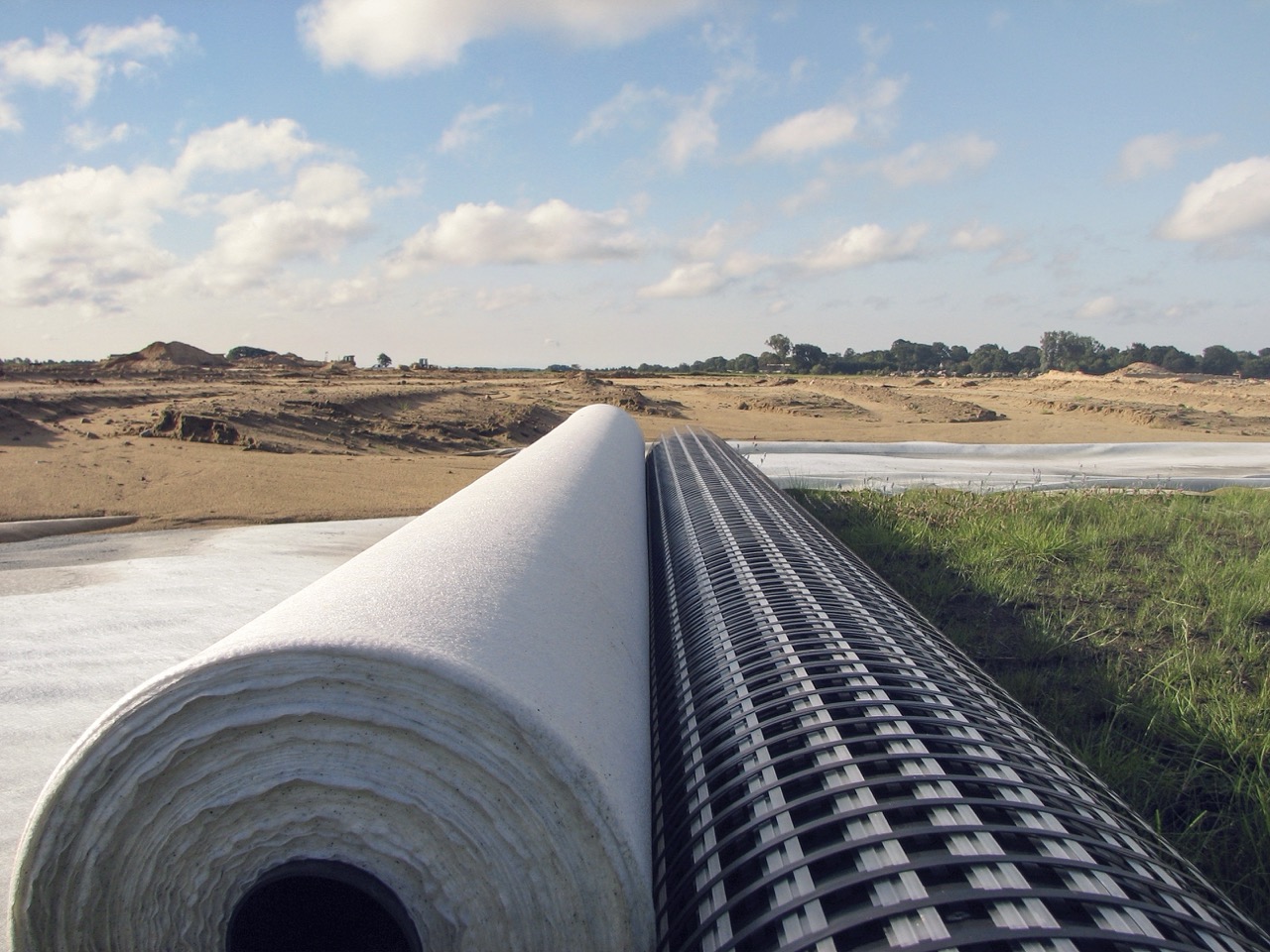
Applications:
- construction of roads, streets, railway lines, tramways, forest roads
- construction of steep slopes of road and railway embankments
- slope failures repair
- construction of retaining walls
- embankment extension works
- landfill embankments
Steel: The smarter choice
The strength and sustainability of steel provides durability and lifespan advantages for construction projects.
Value engineering
With consultative problem solving and the versatility of steel, value engineering ensures adaptable, cost-effective solutions.
Case studies
Discover the full range of real-world implementations and sustainability benefits of ViaCon solutions and expertise.
Welcome to the ViaCon design toolkit
We have put together a selection of useful tools, calculators, information and downloadable resources to help you find what you need quickly and get the most out of your ViaCon system.
Geogrid is used to reinforce soil in a wide range of civil engineering applications. The most common uses include road subgrade stabilisation (reducing aggregate thickness by up to 40%), reinforced earth retaining walls, steep embankment slopes, working platforms over weak ground, railway trackbed improvement and load transfer platforms over piled foundations. By interlocking with compacted fill material, geogrids distribute loads across a wider area and prevent differential settlement.
Modern polymer geogrids are designed for a minimum service life of 120 years when correctly specified and installed. High-density polyethylene (HDPE) and polyester (PET) geogrids resist biological degradation, chemical attack and UV exposure (once buried). Design life calculations follow BS 8006 and account for creep, installation damage and environmental reduction factors. ViaCon can provide product-specific durability data and design life verification for your project requirements.
Geogrids and geotextiles serve different primary functions. A geogrid has an open grid structure designed specifically for soil reinforcement — it interlocks with aggregate to increase load-bearing capacity and slope stability. A geotextile is a continuous fabric (woven or non-woven) that provides separation between soil layers, filtration, drainage and protection. In many projects, geogrids and geotextiles are used together: the geogrid provides reinforcement while the geotextile prevents fine soil particles from migrating into the aggregate layer.