
Non-woven geotextiles
Non-woven geotextiles separate soft subsoils and drain water
Non-woven geotextiles are geosynthetic materials widely used to separate, filtrate and protect soils. They are known for their high water permeability and often applied in the road and railway construction, hydro engineering, ground improvement, forestry and agriculture. These products are made of polypropylene or polyester fibres mechanically joined in the process of needle punching and thermal bonding. Non-woven geotextiles can also be made of 100% biodegradable fibres.
Optimal water permeability
Their high water permeability makes them perfect for filtration and drainage. They prevent soils from migrating into the adjacent material, such as drainage aggregate, while allowing water to flow through the system.
Cost effective
They save labour and transportation costs as they are very light and easy to lay on-site. Needle-punched non-woven geotextiles can be thermally treated to improve mechanical properties and reduce the volume for better transportation efficiency.
Robustness and flexibility
They have very good tear strength, so they are highly resistant to installation damage. High elasticity and adaptability to surface shape also makes them easy to fold and cut on the job-site.
Multifunctional
Non-woven geotextiles are great for filtration, separation, and drainage applications and even protection. They prevent soils from mixing while allowing water to flow, increase the soil strength and decrease the movement of soil particles due to erosion.
Environmentally friendly
Geotextiles are light, thin and consume less resources for installation and transportation than gravel. They extract no dangerous substances to the surrounding environment, so they are toxin-free and eco-friendly.
Easy to plan
Non-woven geotextiles require no professional engineering to plan. They can be widely used according to the typical NorGeoSpec (NGS) or Geotextile Robustness Class (GRK) requirements.
What Is a Geotextile Membrane? Functions, Types and Specifications
A geotextile membrane is a permeable synthetic fabric used in civil engineering to separate, filter, drain, reinforce or protect soil layers. Manufactured from polypropylene or polyester fibres, geotextiles are specified across virtually every sector of UK infrastructure — from highway construction and railway earthworks to drainage systems, landfill engineering and coastal defence. The two principal types are non-woven geotextiles (needle-punched or thermally bonded) and woven geotextiles (interlaced yarns providing higher tensile strength).
ViaCon supplies a comprehensive range of geotextile membranes specified to the BS EN 13249–13257 series of standards, covering applications including roads, railways, drainage, erosion control, reservoirs and tunnels. Each product is characterised by its mass per unit area (g/m²), tensile strength (kN/m), CBR puncture resistance (kN), water flow rate (l/m²/s) and characteristic opening size (O90) — enabling precise specification for every project requirement.
Non-Woven Geotextile for Infrastructure: Roads, Railways and Drainage
Non-woven geotextiles are the most widely specified geosynthetic in UK construction. Manufactured by needle-punching polypropylene staple fibres into a dense, felt-like fabric, they provide an optimal combination of separation, filtration and puncture resistance. In road construction, non-woven geotextiles are placed between the subgrade and capping layer to prevent intermixing of fine and coarse materials — maintaining the structural integrity of the pavement foundation and extending design life.
For railway applications, non-woven geotextiles separate ballast from formation, preventing pumping of fines that leads to track geometry deterioration. In drainage design, they wrap around perforated pipes and stone-filled trenches to act as a filter, allowing water through while retaining soil particles. ViaCon’s non-woven range includes products from lightweight separation fabrics (100 g/m²) through to heavy-duty protection geotextiles (above 1000 g/m²) for use beneath gabion structures, rip-rap and concrete protection systems.
Choosing the Right Geotextile: Woven vs Non-Woven for Your Project
The choice between woven and non-woven geotextile depends on the primary function required. Non-woven geotextiles excel at filtration, separation and protection — their three-dimensional fibre structure provides excellent water permeability while preventing soil particle migration. Woven geotextiles deliver higher tensile strength per unit weight, making them the preferred choice for reinforcement applications such as embankments over soft ground, geogrid-reinforced walls and basal reinforcement.
In many projects, geotextile membranes work alongside other geosynthetics to form integrated systems. Non-woven geotextiles provide the separation and filtration layer in composite systems incorporating geosynthetic clay liners (GCLs), drainage geocomposites and geomats for erosion control. ViaCon’s technical team can recommend the most appropriate geotextile type, weight and specification for your project — contact us for free design support.
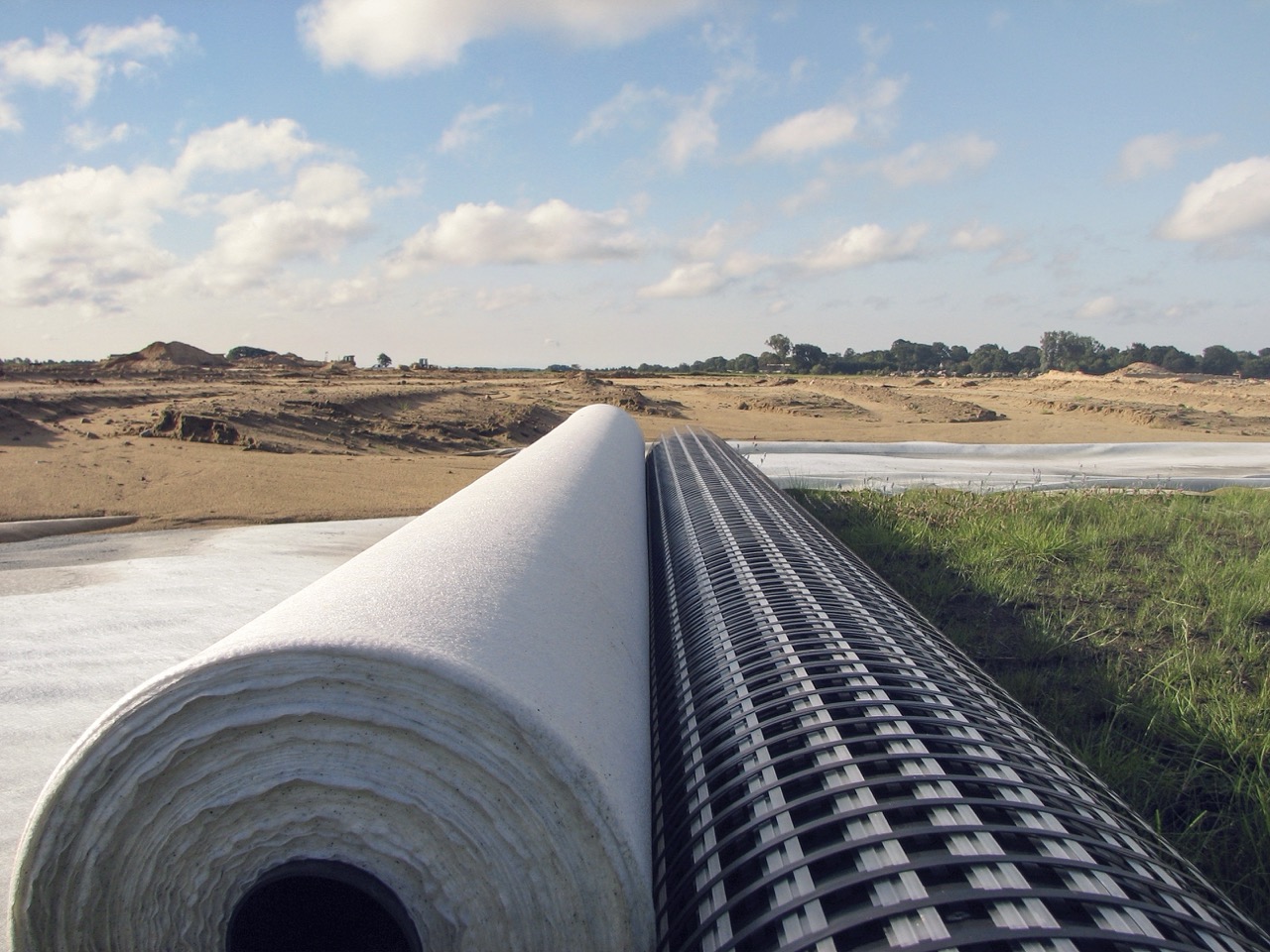
Applications:
- separating soft subsoils under roads and railways
- increasing structure stability
- separating layers between soils or fill layers with a different aggregate size
- riverbanks protection
- reservoirs construction
- vertical and horizontal geosynthetics drains
- drainage systems protection
- cracks preventing layer under concrete pavements
Steel: The smarter choice
The strength and sustainability of steel provides durability and lifespan advantages for construction projects.
Value engineering
With consultative problem solving and the versatility of steel, value engineering ensures adaptable, cost-effective solutions.
Case studies
Discover the full range of real-world implementations and sustainability benefits of ViaCon solutions and expertise.
Welcome to the ViaCon design toolkit
We have put together a selection of useful tools, calculators, information and downloadable resources to help you find what you need quickly and get the most out of your ViaCon system.
A geotextile membrane is used in civil engineering to separate different soil layers, filter water while retaining soil particles, provide drainage pathways, reinforce weak ground and protect waterproofing membranes from puncture damage. Common applications include road construction (separating subgrade from aggregate), railway earthworks (preventing ballast contamination), land drainage (wrapping pipe trenches), landfill engineering (protection and filtration layers) and erosion control (beneath rip-rap and gabion structures).
Yes — geotextile fabrics are specifically designed to be permeable to water while retaining soil particles. Non-woven geotextiles have a three-dimensional fibre structure that allows water to pass through freely in all directions, with typical flow rates ranging from 50 to over 200 litres per square metre per second depending on the product weight. This permeability is essential for their filtration and drainage functions. The characteristic opening size (O90) determines which particle sizes are retained, allowing engineers to match the geotextile to the surrounding soil conditions.
Woven geotextiles are made from interlaced polypropylene or polyester yarns, providing high tensile strength and low elongation — ideal for soil reinforcement, embankment construction and basal reinforcement applications. Non-woven geotextiles are manufactured by needle-punching or thermally bonding staple fibres, creating a felt-like fabric with excellent filtration, separation and puncture resistance properties. Non-woven geotextiles are more commonly specified in the UK for general separation, drainage and protection applications, while woven types are chosen when tensile reinforcement is the primary function.